
2 November 2026 · 7 min read
Underfloor Heating Retrofit: Costs in the Netherlands 2026
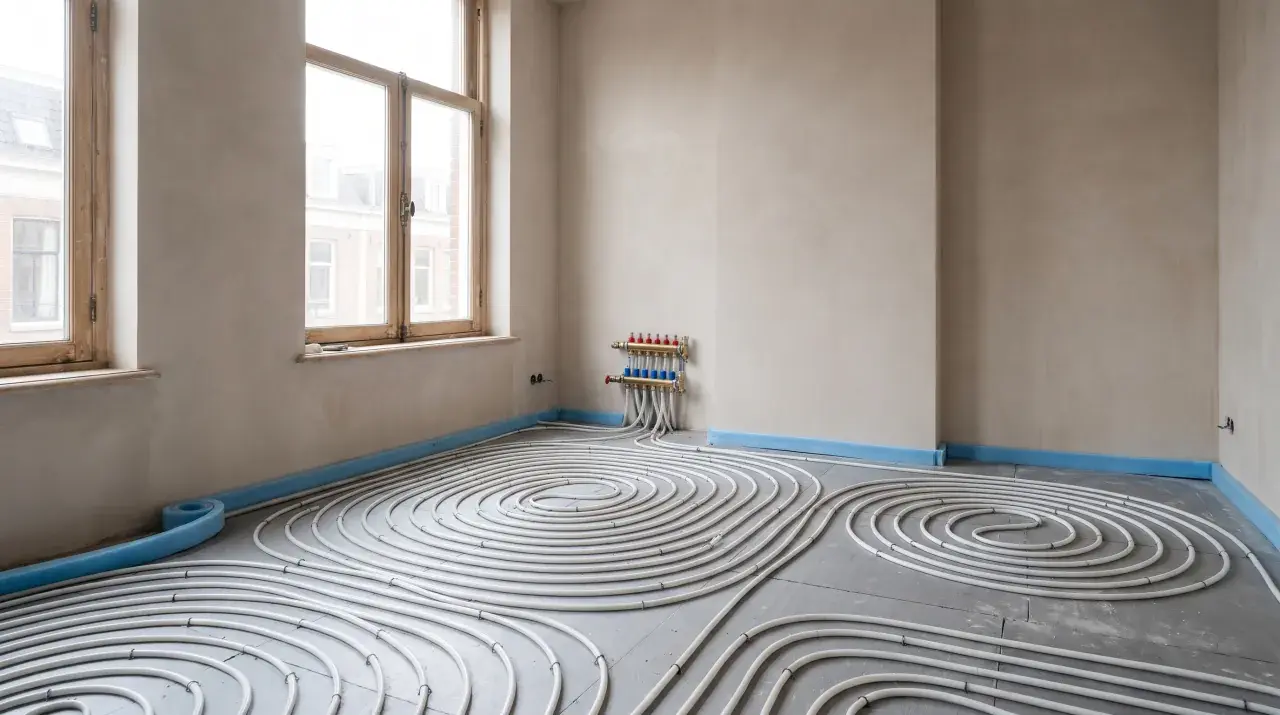
Retrofitting water-based underfloor heating in an existing Dutch home costs €70-€120 per m² including installation, according to Trustoo's price guide of July 2026. Milling the pipes into the existing screed is the cheapest method, at €30-€45 per m² before VAT, and it adds no height. Electric mats cost less to install but a lot to run, so they belong in bathrooms. In Amsterdam the floor you already have decides the method: a sound concrete or sand-cement screed can be milled, a timber floor needs a dry or low-profile system that raises the floor.
What does underfloor heating cost in 2026?
| Method | Floor raise | Price per m² | Suits |
|---|---|---|---|
| Milling into the existing screed | None, pipes sit in 15-20 mm grooves | €30-€45 excl. VAT (Trustoo), €35-€50 incl. VAT (Slimster) | Cement, anhydrite or concrete screed of 5 cm or more |
| Dry or low-profile system on the existing floor | About 16 mm (thin system) to 6 cm or more (panels) | €35-€65 excl. VAT (Trustoo), €70-€100 incl. VAT (Slimster) | Timber floors, floors that cannot be milled |
| Wet system in a new screed | At least 3 cm of screed over the pipes, plus insulation | €30-€50 excl. VAT (Trustoo), €50-€75 incl. VAT (Slimster) | Rebuilt ground floors, extensions |
| Electric mats | 3-5 mm | €35-€60 (Trustoo), €50-€120 with thermostat (Selectra) | Bathrooms, small rooms |
Some guides quote with VAT, some without, so compare quotes on the same basis. Pipe spacing matters too: main heating needs pipes 10 cm apart, supplementary heating 15-20 cm, and Homedeal prices them at €70-€120 and €40-€80 per m². Trustoo splits a typical bill into about 50% materials, 40% labour and 10% call-out costs.
| Example | Price | Source |
|---|---|---|
| Bathroom 5 m², electric mat | €250-€600 | Selectra |
| Living room 40 m², water-based | €2,800-€4,800 | Trustoo |
| Living room 40 m², electric | €1,400-€2,400 | Trustoo |
| Living room and open kitchen 45 m², milled, main heating | €1,750-€1,950 incl. VAT | Slimster |
| Ground floor 60 m², milled, main heating | €2,400-€2,800 incl. VAT | Slimster |
| Whole home 100 m², main heating | €6,400-€8,000 incl. VAT | Homedeal |
The floor around the pipes is a separate budget: Trustoo (September 2026) puts removing an old floor at €3-€30 per m² and levelling at €10-€75 per m², before the new finish. Underfloor heating has no subsidy of its own in 2026; a heat pump or floor insulation done at the same time can qualify for ISDE (Trustoo). The work carries 21% VAT; the 9% rate covers only a few jobs such as insulating, painting and plastering (Belastingdienst).
How much height does underfloor heating add, and what about the doors?
Milling adds nothing: a machine cuts 15-20 mm grooves into the screed, the pipe goes in and the finish goes straight on top (Homedeal). Vasco, a maker of milling systems, requires a dry, flat cement or anhydrite screed of at least 5 cm and extracts the dust with a HEPA vacuum. A timber floor can usually not be milled (Homedeal).
Otherwise the floor goes up. A low-profile system, a studded sheet with thin pipes glued to the existing screed, boards or tiles and filled with levelling compound, adds about 16 mm (Uponor). Dry panel systems start at about 6 cm (Slimster). A new wet screed needs at least 3 cm over the pipes (Kwaliteit Parket), plus insulation.
Then the doors. The Dutch noise foundation NSG notes that a heavy floating floor raises the floor by many centimetres, so doors, thresholds and kitchens get in the way. Measure door gaps, the kitchen plinth and the top stair before choosing.
Can you lay underfloor heating on a timber floor in an old Amsterdam home?
Yes, but not by milling. Many pre-war Amsterdam homes have timber joist floors, and Trustoo names the dry system as the method for renovations and wooden floors: insulation panels with grooved heat-spreading plates under dry screed boards, dearer than a wet system (Kwaliteit Parket). A wet screed adds weight and moisture old joists were not designed for, so have them checked by a structural engineer first.
Noise is the second issue. According to NSG, footstep noise is the most common neighbour complaint, especially in old apartment buildings with timber floors. There the low tones dominate, and a springy underlay helps little: one that gains 10 dB on concrete gains no more than 5 dB on timber. NSG advises a heavy, stiff build-up and a ceiling hung free of the joists below. If the floor is open anyway, plan the heating with the acoustic work.
What does the VvE require for underfloor heating in an apartment?
Start with the splitsingsakte and the huishoudelijk reglement: they decide whether the VvE must approve a new floor build-up. Underfloor heating works best under hard floors, which house rules regulate. NSG's model rule asks that a hard floor on concrete improves contact-sound insulation by at least 10 dB (ΔLlin), carries 3 stars under NTA 5098 or an NSG mark, or that a measurement shows LnT,A of at most 49 dB. The toilet, the bathroom and 3 m² of kitchen are exempt.
Check the screed before milling. NSG warns that in some buildings it is not bonded to the concrete, which sounds hollow when you knock, and since 2003 many buildings have a screed floating on a resilient layer. Bring the VvE a drawing, the build-up and the underlay data. In a listed building, changing a part with monumental value, such as an original floor, needs a permit (Ondernemersplein, RVO). More in our guide to permits, monuments and VvE rules.
Does underfloor heating work with a heat pump?
Yes. Milieu Centraal calls underfloor heating the most comfortable and economical match for a heat pump and advises milling it in when you renovate or lay a new floor (October 2026). A heat pump supplies water of at most 55 °C, a gas boiler up to 80 °C. Underfloor heating runs on 30-40 °C, radiators on 60-80 °C (Slimster).
It is not a must: Milieu Centraal says larger low-temperature radiators also work. Insulation is the real requirement: at least Rc 2.5 in roof and floor (8-12 cm), insulated cavity walls and HR++ glass. Test it by setting the boiler's heating water to 50 °C during a cold spell. On a ground floor over a crawl space, insulate under the floor first, see insulation and ventilation.
Electric underfloor heating draws 100-150 W per m². A 5 m² bathroom floor heated 1.5-2 hours a day costs about €40-€90 a year at January 2026 prices, but it is rarely enough to remove the radiator (Selectra), and Trustoo warns of high running costs for long use. It is comfort heat in a bathroom renovation, not main heating.

Which floor works over underfloor heating: tiles, wood or PVC?
Tiles, natural stone and poured floors pass heat best (Homedeal). Wood works within limits. Kwaliteit Parket caps the thermal resistance of parquet at 0.15 m²K/W; glued-down parquet reaches about 0.12, so over main heating it must be glued. The water may not exceed 40 °C, the screed surface 28 °C and the wood 25 °C. Oak suits; beech and maple are not advised. No rugs on top, and keep the relative humidity at 50-60%.
For PVC and laminate, check the thermal resistance including the underlay on the product sheet; thick underlays trap heat. Our comparison of wood, PVC and laminate floors covers the finishes, and finished floors are on our floors page.
How long does installing underfloor heating take?
- Milling: often done within a day (Homedeal), and tiles can go straight onto the grooved screed (Vasco).
- Low-profile system: about three days including the floor (Uponor).
- Dry system: the heating can start within 24 hours and the floor can follow (Kwaliteit Parket).
- Wet screed: about a week of drying per centimetre and at least four weeks, then a 15-day heating protocol before parquet (Kwaliteit Parket).
The pipes last 40-50 years, the manifold and pump 15-20 years (Homedeal).
Common mistakes with underfloor heating in an existing home
- Supplementary spacing of 15-20 cm sold as main heating, which needs about 10 cm.
- Milling into a screed thinner than 5 cm or one that sounds hollow.
- Laying parquet without the heating protocol, on a screed that is still too wet.
- A thick underlay or a rug that keeps the heat in the floor.
- Forgetting the doors, thresholds and kitchen plinth, or starting before the VvE has approved.
Tommy's Service fits underfloor heating in bathrooms, new floors and complete renovations, with one site manager. We reply within one working day, visit for free to check the floor, the height and the VvE rules, and send a written quote. For a first range, try our online renovation calculator or get in touch.
Frequently asked questions
- How much does underfloor heating cost per m² in the Netherlands?
- Water-based underfloor heating costs €70-€120 per m² including installation (Trustoo, July 2026). Milling it into an existing screed costs €30-€45 per m² excluding VAT, and electric mats €35-€60 per m². The old floor, levelling and the new finish come on top.
- Can you install underfloor heating in an existing home without raising the floor?
- Yes, by milling the pipes into the existing screed, which needs a dry, flat cement or anhydrite screed of at least 5 cm (Vasco). A timber floor can usually not be milled; a low-profile system on top adds about 16 mm.
- Can you put underfloor heating on a timber floor?
- Yes, with a dry or low-profile system rather than milling or a heavy wet screed. Have the joists checked first, and in an apartment plan the acoustics too: on timber floors springy underlays do little against footstep noise (NSG).
- Do I need VvE permission for underfloor heating?
- Check the splitsingsakte and the huishoudelijk reglement of your building. The model rule NSG proposes for hard floors asks for a contact-sound improvement of at least 10 dB (ΔLlin) or a level LnT,A of at most 49 dB. Bring the build-up and product data to the VvE before work starts.
- Is electric underfloor heating expensive to run?
- It uses 100-150 W per m². A 5 m² bathroom heated 1.5-2 hours a day costs about €40-€90 a year (Selectra, 2026 prices). As main heating on a large floor it becomes expensive, so use it for bathrooms.
- How long does it take to install underfloor heating?
- Milling is often done within a day (Homedeal). A low-profile system takes about three days including the floor. A new wet screed needs about a week of drying per centimetre plus a 15-day heating protocol before parquet.
- Is there a subsidy for underfloor heating in 2026?
- Not for underfloor heating on its own (Trustoo, 2026). A heat pump or floor insulation done at the same time can qualify for the ISDE subsidy.
Sources and further reading
- Vloerverwarming kosten - Trustoo, 13 July 2026
- Vloer leggen kosten - Trustoo, 7 September 2026
- Wat kost vloerverwarming in 2026? - Slimster, 17 April 2026
- Elektrische vloerverwarming badkamer - Selectra, 10 August 2026
- Vloerverwarming prijs - Homedeal, 14 November 2025
- Vloerverwarming infrezen kosten - Homedeal, 14 November 2025
- Volledig elektrische warmtepomp - Milieu Centraal, 29 October 2026
- Handreiking voor verhuurders en VvE's: harde vloerbedekking op betonvloeren - Nederlandse Stichting Geluidhinder (NSG), 28 October 2022
- Loopgeluid en oude etagewoningen - Nederlandse Stichting Geluidhinder (NSG), 23 January 2019
- Parket op vloerverwarming - Kwaliteit Parket
- Freessysteem vloerverwarming, productblad - Vasco, 10 November 2022
- Uponor Minitec, wet installation - Uponor
- Werkzaamheden aan woningen: 9% btw - Belastingdienst
- Omgevingsvergunning beschermde monumenten verbouwen of slopen - Ondernemersplein (RVO)