
16 June 2025 · 7 min read · Last updated 17 September 2026
Keeping a Dutch Home Cool in Summer: What Actually Works
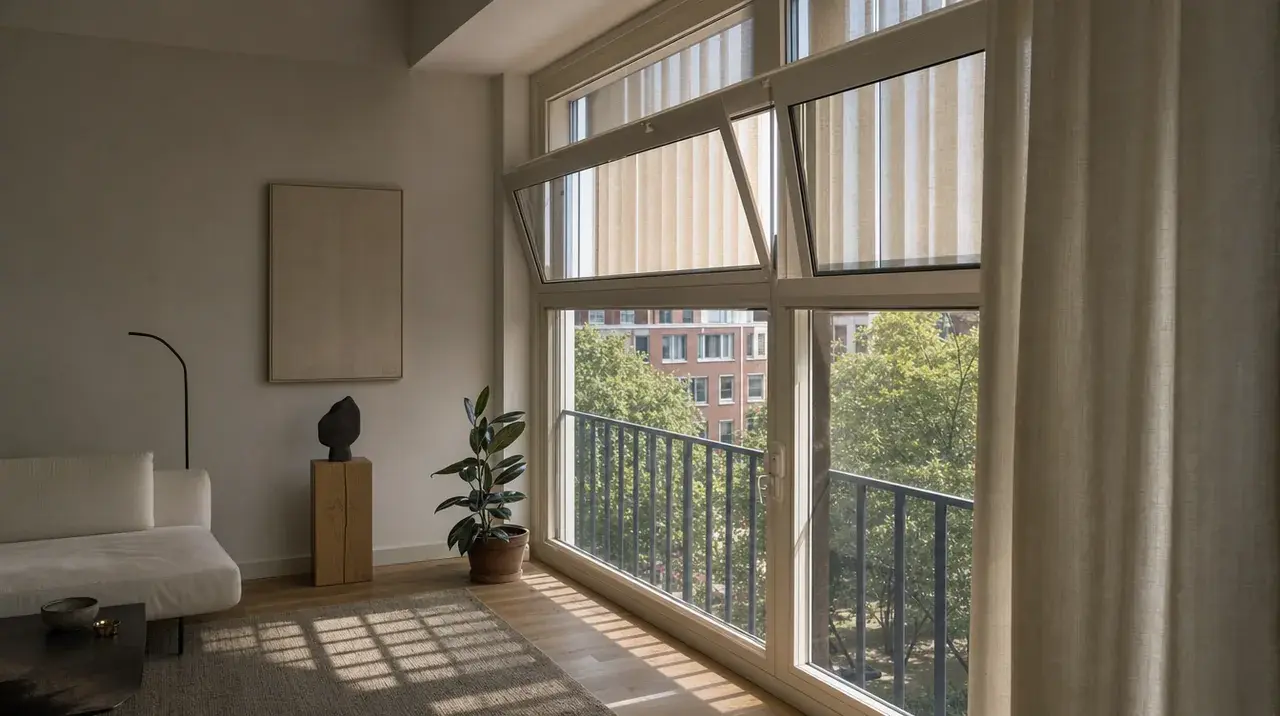
Third day of a heatwave, a top-floor flat in Amsterdam-Oost. Outside it is 31 °C; in the bedroom under the roof it is 29 °C at midnight and the fan only moves warm air around. The flat was insulated two years ago and the heating bill halved - which is the point people miss. The same fabric that keeps January out will happily keep July in. Summer comfort is a separate problem with its own order of operations.
The order is simple. Stop the sun before it reaches the glass. Slow the roof so the peak arrives late. Get the heat out at night. Only then consider a machine. Reversed - airco first, shading never - you pay to cool a room refilled with sunshine every afternoon.
Where the heat actually comes from
In a Dutch house the dominant summer gain is solar radiation through glazing, not conduction through walls. A square metre of unshaded south- or west-facing glass can admit several hundred watts on a clear day; a west-facing bedroom is the classic reason a room is still 28 °C at bedtime. Roof glazing is worse: a skylight faces the midday sun almost head-on, and an internal blind above it becomes a small radiator.
Two Dutch specifics sharpen it. Terraced and canal-side houses have almost no roof overhang, so façades take direct sun all day, and upper floors are light construction - timber joists, plasterboard, a thin roof build-up - with little thermal mass to absorb the peak. Add a run of tropical nights, when the outside temperature never drops below 20 °C, and the free night cooling Dutch homes rely on stops working. Interiors drift several degrees above the outside temperature and stay there.
Shading first, and it has to be on the outside
This is the highest-value move. External shading - screens, shutters, awnings, a brise-soleil - stops the energy before it passes the glass and removes most of the solar gain. An internal blind cannot: the heat is already in the room and re-radiates from the fabric. In a west-facing bedroom that is the difference between sleeping and not sleeping.
For most houses, motorised zip screens are the practical answer: a fabric with an openness factor of around 3-5% cuts glare and heat while keeping a usable view, and side rails stop it flapping on an exposed façade. Automate them with a wind sensor: down by mid-morning on the sun-facing elevation, up at dusk so the glass can radiate heat away. Indicatively, €700-€1,500 per window for a fitted motorised screen, less for a fixed awning; solar-powered versions avoid chasing cable into finished rooms.
The catch in Amsterdam is the façade. Screens and awnings change the exterior, so on a monument or in a protected streetscape a street-façade installation usually needs permission, and in an apartment building VvE consent as well. Rear façades, roof terraces and courtyards are far easier, and that is where we start. Where the front is untouchable, the fallback is sun-control glazing behind the existing sash - less effective, but legal. Our guide to permits, monuments and VvE approvals sets out who has to say yes to what.
Glazing: the g-value matters as much as the U-value
The U-value is a winter number: how fast heat escapes. The summer number is the g-value (in Dutch, ZTA) - the fraction of solar energy that gets through. Standard HR++ glass sits around 0.6, so most of the sun comes in; solar-control glass drops that to roughly 0.25-0.40, with triple glazing in between. The trade-off is real: a lower g means less daylight and less free winter heat, so it belongs on south and west glazing and on skylights, not on north-facing windows where it costs light for nothing.
Because glass is expensive to change on its own, this is a decision for when frames are being replaced anyway - specified per orientation, not one product for the whole house. How Dutch window specifications have evolved is worth understanding first, and we go through it in our piece on how Amsterdam windows have changed. For roof windows, an external awning does more than any glass upgrade, and costs less.
Insulation: choose it for the time delay, not only the Rc
Roof insulation is the second lever, and the material matters more in summer than most quotes admit. Rigid PIR or PUR gives a high Rc per millimetre, excellent in winter, but does little to slow a heat wave because it stores almost no heat. Denser fibrous materials - wood fibre, cellulose - store considerably more and delay the daily peak by hours. In a converted loft, that shift moves the heat from mid-afternoon to late evening, when you can vent it out of the window.
Where the roof depth allows, aim well above the Bbl renovation minimum; Rc 4.5-6.0 is a sensible target, with continuous airtightness and a vapour-open build-up so the construction can dry. Airtightness without a ventilation strategy is how a warm renovation turns into a mouldy one, the argument in our guide to insulation and ventilation in Dutch homes. On a flat roof due for renewal, a light reflective coating is a cheap addition that drops surface temperatures. Floor and crawl-space insulation, by contrast, earns its money in winter and on your energy label - it will not make July better.
Ventilation: the night purge, done properly
Cooling a Dutch house is mostly timing. Keep windows and screens shut while the outside air is warmer than the inside, then open up in the evening and flush the house overnight - best with two openings on opposite façades, or a stack path up the stairwell to a roof vent. Security is the usual objection; lockable ventilation positions or secured louvres answer it.
If you have mechanical ventilation with heat recovery, check the summer bypass is working - otherwise the unit spends August politely recovering heat you are trying to lose - and run a boost overnight rather than at midday. On a tram route, sound-attenuated night vents let you purge without opening a window to the noise.
What not to do
- Single-hose portable air conditioners. The exhaust hose out of a tilted window puts the room under negative pressure, so hot outdoor air is pulled in through every gap to replace it and much of the cooling is cancelled. A split unit is legitimate, but as a last step, not a first one.
- Installing an outdoor unit without checking the rules. Since April 2021 its noise at the neighbouring plot boundary is capped at 45 dB(A) by day and 40 dB(A) at night, and in an apartment building a unit on the façade or roof needs VvE approval, plus a permit if it is visible from the street.
- Blacking out the house. Screens with a 3-5% openness factor keep daylight and a view; shutting everything for three months is a poor trade.
- Relying on greenery alone. A climber cools a sunny wall a little and a deciduous tree or pergola does more, but neither replaces shading on the glass - and vigorous ivy on soft lime mortar is no friend to an old façade.
A sensible order, and what it costs
- External shading on the sun-facing glazing first: the fastest measurable improvement in a bedroom.
- Roof insulation, with the material chosen for its time delay: indicatively €60-€120 per m², depending on whether it is done from inside or with a new roof covering.
- A reflective coating on a flat roof being renewed anyway: around €25-€40 per m².
- Solar-control glazing, specified per orientation, when frames are replaced anyway.
- Subsidies last: ISDE covers part of the cost of insulation measures, subject to minimum Rc values and surface areas, and the amounts and conditions are revised annually - check the current RVO rules before ordering, and look at Warmtefonds financing for larger packages. Shading itself is generally not subsidised. Combined measures are best planned as one package, which is how we approach energy-focused renovations.
All figures here are indicative ranges for Noord-Holland; the right answer depends on orientation, building type and what the VvE or the municipality allows. If your bedroom is under the roof and you are weighing an air conditioner against a proper fix, send us the orientation and a few photographs of the façade and we will say honestly which measures your building will reward, and in which order.