
8 August 2025 · 7 min read · Last updated 17 September 2026
Permit or No Permit? Amsterdam Renovation under the Omgevingswet
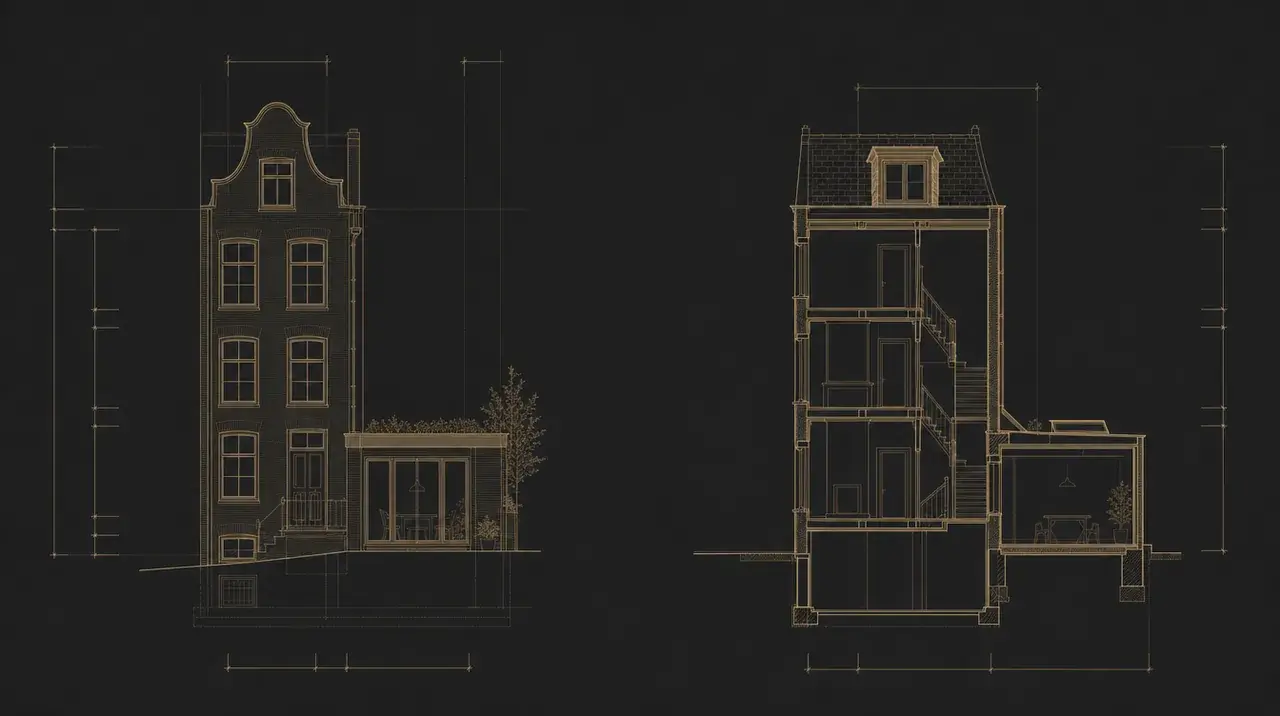
Almost every project starts with the same sentence: it is all internal, so we do not need a permit, do we? Sometimes that is right. Just as often it is right for the national building rules and wrong for the municipal plan, or right for the municipality and wrong for the VvE. Since the Omgevingswet came into force on 1 January 2024, that question has a different shape than the one most online advice answers.
What the Omgevingswet changed, and why older advice goes stale
Under the old Wabo, one omgevingsvergunning covered everything. Now the work is assessed in two separate strands. The technical side, the technische bouwactiviteit, is judged against national rules in the Besluit bouwwerken leefomgeving, the Bbl, which replaced the Bouwbesluit. The spatial side, the omgevingsplanactiviteit, is judged against your municipality's omgevingsplan. A project can be exempt on one side and caught on the other, which is why two reliable sources can tell you two different things.
The second change is slower but just as important. Every municipality now has one omgevingsplan, built from its old bestemmingsplannen plus the bruidsschat, former national rules handed over for municipalities to rewrite in their own words by 2032. Until then the same dormer can be judged differently in Amsterdam, Amstelveen, Zaanstad or Haarlem, and the rules on your street can change between design and build. Nobody can give you a reliable verdict from a photo.
Three questions decide the permit, and a fourth decides whether you can start
- Does the work touch the load-bearing structure, fire separation between dwellings, or the volume of the building? That is the technical strand, and it usually ends the permit-free conversation.
- Does it change what is visible from public space, or what the omgevingsplan allows on your plot? Facade, roof, dormers, balconies and extensions all live here.
- Is the building a rijksmonument or a gemeentelijk monument, or does it stand inside a protected cityscape? If yes, assume a permit and plan the calendar around it.
A fourth question sits outside public law and stops as many projects: what does your VvE allow? The municipality can call your work permit-free while your splitsingsakte forbids it.
Work that is usually vergunningvrij in an ordinary Amsterdam home
With no monument status and no protected streetscape, the following usually falls outside the permit, provided the Bbl and omgevingsplan conditions are met:
- A new bathroom in the same position, with no change to load-bearing walls and no new opening in the facade.
- A kitchen moved two or three metres, as long as drainage falls and the ventilation route can be solved inside the dwelling.
- Removing a non-load-bearing partition. Verify it first: in early twentieth-century blocks, a wall that looks like a partition sometimes carries a joist end or a flue.
- Underfloor heating and a new screed, subject to the noise clause in your splitsingsakte.
- Solar panels laid in the plane of a sloping roof, facing the same way as the roof surface, but not on a monument and usually not in a protected cityscape.
- Internal insulation, and rear kozijnen replaced like for like in the same appearance, material and colour.
Permit-free is not rule-free, and that is where people get hurt. The Bbl applies in full: structural safety, fire, daylight, sound insulation between dwellings, and ventilation capacity, where 75 m³ per hour for a kitchen is a floor and not an ambition. Neighbour law applies too: a window or balcony overlooking your neighbour within two metres of the boundary needs their consent.
Work that usually needs an omgevingsvergunning
- Removing or opening a load-bearing wall, cutting a stair opening, or adding load to an existing floor. Expect to supply a calculation from a registered constructeur.
- A dormer on the street side. Rear dormers are sometimes permit-free within the national limits on height, roof shape and distance to ridge and edges, but the omgevingsplan can override that, so this is genuinely case by case.
- New or altered kozijnen in the front facade, or changes to profiles, divisions and glazing bars that alter the streetscape.
- New penetrations in roof or facade for extraction, MVHR intakes or an outdoor heat-pump unit, where appearance rules and noise limits both apply.
Monuments and protected cityscapes: assume yes, and start early
For a rijksmonument or gemeentelijk monument, gewoon onderhoud, genuine like-for-like maintenance in the same material, colour and detail, stays permit-free. Anything affecting monumental value does not, and the protection reaches inside the building: stucco, panelled doors, mantelpieces, floor structure and staircases can be protected even when nothing changes on the facade. Clients are regularly surprised that an interior renovation in a canal house triggers a permit.
So allow real time for assessment, budget for reversible details, and document what exists before you touch it. We design the reversible option first and the ideal option second, then let the assessment choose. The longer version of that framework is in our decision guide for monuments and VvE approvals, and the access side in the logistics of renovating a grachtenpand.
The Omgevingsloket check is the step that actually counts
Everything above predicts the answer. The authoritative answer comes from the vergunningcheck in the national Omgevingsloket, run against your address and your exact scope, and from the municipality itself. For anything borderline, ask for a conceptverzoek: you describe the plan, the municipality responds informally, and you learn whether you are heading for a fight before you pay for full drawings.
Two meldingen are easy to forget. Demolition producing more than ten cubic metres of waste, or any asbestos removal, needs a sloopmelding in advance, and asbestos in a building from before 1994 must be surveyed and removed by a certified firm. Separately, the Wet kwaliteitsborging voor het bouwen applies to new build and its extension to renovation has been postponed more than once, so check its status when you build.
The VvE is a second approval in all but name
In an apartment building the facade, roof, window frames, load-bearing walls, risers and often the floor construction are gemeenschappelijk. Changing them needs a decision of the vergadering, and the majority required depends on which modelreglement your splitsingsakte follows. Most aktes carry a hard-floor clause demanding at least 10 dB improvement in contact noise, which decides your floor build-up before you pick a material.
What makes a VvE say yes quickly is a complete packet: drawings, a written scope, acoustic and insulation data sheets, a logistics and waste plan, working hours, and proof of liability insurance. What makes it say no is a vague request two weeks before the start date.
Time, fees, and the six weeks after the yes
The standard procedure runs eight weeks from a complete application, with a possible six-week extension; sensitive cases fall into the extended route of around six months. Leges are set locally, usually as a percentage of the construction sum, so ask for your municipality's legesverordening rather than trusting a figure from a blog. After a permit is granted, neighbours have six weeks to object; you may start during that window, at your own risk.
Bundle the energy work while the dust is already up
An open floor and a stripped wall are the cheapest hour you will ever have for insulation, airtightness detailing, MVHR ducting or the electrical preparation for a future heat pump. One mobilisation, one set of approvals. The trap is airtightness without ventilation, which is how Dutch homes get mould; that balance is set out in our guide to insulation and ventilation.
A sensible order of operations
- Define the scope precisely: structural or not, front or rear, roof or not, and what changes outside.
- Check building status: rijksmonument, gemeentelijk monument, protected cityscape, or none of these.
- Run the Omgevingsloket vergunningcheck for both strands, technical and plan.
- Ask for a conceptverzoek if anything is borderline, before drawings are finalised.
- Prepare the VvE packet in parallel, not afterwards, and only then fix the design, budget and start date.
The honest summary: permit-free is common for interior work and rare the moment you touch structure, facade, roof or a monument, and the VvE is as decisive as the municipality. Do the checking in week one and the rest of the project stays calm. If you would rather not do that alone, tell us what you are planning and we will run the check, prepare the VvE packet and build the approvals into the schedule.