
Silent Luxury: Acoustic Design for Amsterdam Apartments and Canal Houses
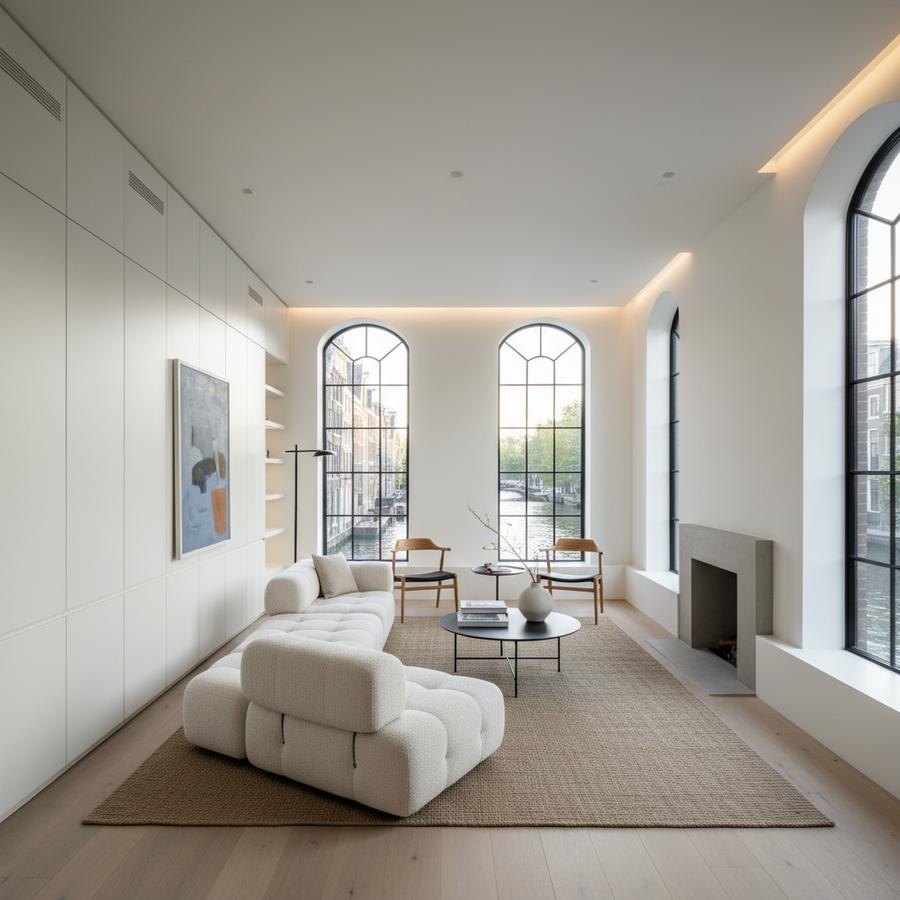
If you live in Amsterdam, sound is part of the city’s DNA—trams, party boats, cyclists, neighbours on timber floors. Yet a truly refined renovation delivers quiet as a design feature. Today’s angle is acoustic comfort: how to engineer silence in historic and modern Dutch homes while respecting structure, rules, and aesthetics.
Start with a sound map: what, where, when
Before specifying materials, diagnose the noise. Note time, source, and path for one week:
- Airborne: voices, traffic, music penetrating windows and party walls.
- Impact: footsteps, chair legs, subwoofers transferring through timber beams.
- Services: humming MVHR units, bathroom fans, gurgling drains.
Standards like NEN 5077 define performance for new build, but existing Amsterdam stock often underperforms. Your goal is a layered strategy that blocks, cushions, and seals—without hard bridges that short-circuit results.
Floors on timber beams: mass-spring-mass that actually works
Most pre-war homes sit on timber joists. The winning formula is a decoupled floating floor:
- Level and isolate: Add perimeter isolation tape at walls. Keep the new floor “floating,” never screwed into joists.
- Resilient layer: 8–12 mm recycled rubber/cork or specialist acoustic underlayment.
- Mass layers: Two staggered 12–15 mm cement boards or high-density gypsum fibre (e.g., 2 x 12.5 mm), seams offset and sealed.
- Finish: Engineered oak with acoustic underlay, or a thick wool carpet in bedrooms for extra impact control.
Expect 15–25 dB improvement in impact noise if detailed correctly. If a downstairs neighbour complains, a resilient ceiling under your floor is even better: metal channels on acoustic clips, 50–70 mm mineral wool, and double acoustic gypsum (2 x 12.5 mm). Keep an eye on headroom—canal houses often have precious little.
Structural caution: Added mass on old beam floors is not trivial. As a rule of thumb, keep new layers under 50–75 kg/m² unless a structural engineer reviews joist span, spacing, and bearing. Pile foundations and settlement quirks in Amsterdam demand respect.
Windows and facades: tame the city without losing character
Façade noise dominates near canals and tram lines. You can substantially boost performance while preserving heritage detailing:
- Secondary glazing: For listed façades or when Monumentenzorg constraints apply, fit slim internal secondary glazing. A large air cavity (80–150 mm) and asymmetric laminated panes (e.g., 6.4/12/10.8) provide excellent Rw + Ctr values.
- Replacement glazing (where allowed): Specify units by acoustic class (Rw + Ctr), not just HR++ or triple. Laminated glass is your friend against traffic noise.
- Airtightness: Brush seals to sash boxes, compressible seals to meeting rails, and acoustically baffled trickle vents. Tiny gaps equal big decibels.
Permits: internal secondary glazing usually avoids altering the exterior appearance and is often acceptable under Monumentenzorg. Always confirm with the municipality; an omgevingsvergunning may be required if profiles or sightlines change.
Party walls that actually hush
Many Amsterdam walls are single-brick or cavity masonry, often irregular. Build an independent lining:
- Free-standing stud 20–50 mm clear of the wall (no rigid ties), with 50–70 mm mineral wool.
- Double acoustic boards (e.g., 2 x 12.5 mm), seams staggered, edges sealed with acoustic mastic.
- Detail outlets: Avoid back-to-back sockets with neighbours; use putty pads and offset them.
This can deliver 10–15 dB improvement in airborne noise if flanking paths (floors/ceilings) are also addressed.
Doors, corridors, and quiet zones
Bedrooms need more than pretty paint. Use architecture to stage sound:
- Solid-core doors with perimeter and drop seals—aim for doorset Rw 32–37 dB.
- Vestibules or small lobbies to create an acoustic buffer between living spaces and sleeping areas.
- Pocket and sliding doors can work if you specify acoustic models with brush seals and bottom guides—standard sliders leak.
Soft finishes matter: a thick rug on timber floors and heavy curtains reduce reverberation and perceived loudness without structural work.
Quiet building services: comfort without hum
High-end comfort includes silent ventilation and plumbing:
- Ventilation: In bedrooms, target ≤ 25 dB(A). Mount MVHR/MEV units on anti-vibration pads, use flexible connectors, and add silencers on supply and extract. Keep grilles away from headboards.
- Plumbing: Box drainage with double board and 50 mm mineral wool; choose decoupled WC frames and avoid risers in party walls. Use acoustic pipe lagging on rainwater and soil pipes.
Detail penetrations ruthlessly. Every cable, pipe, or downlight is a potential leak—grommets and acoustic mastic are inexpensive and effective.
VvE rules, permits, and documentation
Many Amsterdam VvE house rules require demonstrable impact improvement from hard floor finishes, often ΔLlin ≥ 10 dB. Choose systems with test certificates and keep datasheets for VvE approval. For heritage façades, coordinate early with Monumentenzorg and the municipality. If you alter façades, structure, or escape routes, you may need an omgevingsvergunning under current Bbl frameworks.
Budgets and sequencing that save headaches
- Dry floating floor: €80–140/m² (materials and install, finishes excluded).
- Resilient acoustic ceiling: €120–220/m².
- Independent wall lining: €90–160/m².
- Secondary glazing: €800–1,200/m² of window.
- Solid-core acoustic doors: €300–700 per leaf; seals €150–300 per set.
- Ventilation silencers and mounts: €150–300 per duct path.
Sequence for success:
- 1) Façade airtightness and glazing first (reduces outside noise and improves comfort immediately).
- 2) Structure and linings: floors, ceilings, and party walls without bridging.
- 3) Services: mount and silence fans, ducts, and pipes before closing linings.
- 4) Finishes: rugs, curtains, and soft furnishings to tune reverberation.
Design without compromise
Acoustic performance can be beautiful. Microperforated timber ceilings read as refined joinery. Slatted oak walls conceal absorbers. Deep velvet curtains frame canal views while calming echoes. The key is coordination: structural engineer for loads on timber beams, an acoustic consultant for targets and details, and a contractor who understands that a single screw bridging a floating floor can undo weeks of planning.
In a city that never sleeps, luxury is silence. Engineer it deliberately, and your Amsterdam home will feel composed—no matter what the street is doing outside.